The Texture Trap: When Surface Stands In for Material
Learn how to read material beyond its finish: spot what texture reveals, what it conceals and which clues help you judge an object more clearly.
A chair seat can look like rough linen and feel faintly nubby, yet be made from moulded plastic. That small surprise is the texture trap: surface speaks loudly, while the material beneath it may tell a different story. To read material well, treat texture as one clue, not a full account.
1. Separate finish from substance
A finish is the visible or tactile layer at the outside of an object. It might be a glaze, paint, veneer, coating, embossing or deliberately roughened surface. The substance is what gives the object its body: timber, metal, ceramic, polymer, glass, stone or a composite.
The two can work together, but they need not resemble one another. A metal lamp may have a powder-coated surface that feels soft and matte. A sheet of plastic can carry a convincing wood grain, while a timber cabinet may be sealed until its natural texture is hard to feel.
This distinction matters because the finish is often the part people meet first. It can shape appearance, grip, reflection and the impression of warmth. It does not, by itself, disclose how the object is built or how it will respond to use.
2. Read texture as evidence
Texture can offer useful clues. A close look may reveal repeating embossing, a printed grain, brush marks, pores, tool traces or tiny variations in a glaze. Under raking light, raised and recessed areas cast different shadows; a magnifying glass can make a repeated pattern easier to spot.
Touch adds another kind of evidence. A surface might feel cool, slick, powdery, waxy or slightly yielding. But sensation is shaped by temperature, coating, thickness and the room around the object. Coolness can suggest metal or stone, yet it is not a reliable identification on its own.
Consider what the texture is doing, too. A pebbled finish may make a smooth object easier to hold. A matte coating may cut glare. A rough surface may be decorative, or it may help disguise marks. These are functions of the exterior, not proof of the material underneath.
3. Look for the hidden edge
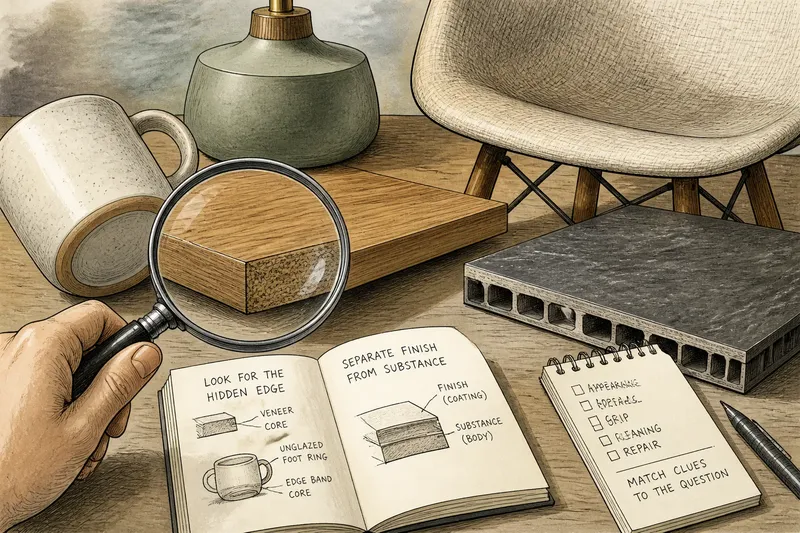
Where a surface ends, construction often becomes easier to read. On a tabletop, inspect the underside and edge: does a grain pattern continue through the thickness, wrap around a corner, or stop abruptly? A neat edge band can cover a core made from a different material. On a ceramic mug, the foot ring may show an unglazed body where the glossy coating ends.
These boundary clues are more informative than a broad, uninterrupted face. Seams, joints, cut-outs and openings may expose layers or reveal how separate parts meet. Look for an honest transition rather than assuming that one visible finish covers every face.
Say you are choosing a shelf that appears to be solid oak. You notice the grain repeats across the top and continues over a thin strip at the edge, while the underside has a different, uniform pattern. That does not settle the material question, but it gives you a useful reason to check the product description for veneer, engineered board or solid timber.
4. Match clues to the question
Before judging a material, decide what you need to know. For appearance, examine colour and pattern in the light where the object will sit. For grip, feel the surface with dry hands. For cleaning, look for care instructions and the presence of grooves or seams where dirt might collect. For repair, ask whether the finish can be renewed separately from the body.
A single surface test cannot answer all of these. A glossy coating might wipe clean but show fingerprints. A deeply textured panel may hide small scuffs while catching dust. A soft-touch finish can feel inviting without telling you whether the body is wood, metal or plastic.
Useful evidence comes from several directions: the object’s edges, its underside, visible joints, the maker’s material description and care label. For an item you cannot inspect, request a sample or a close image of an unfinished edge if that is available. Treat marketing words such as “stone effect” or “wood look” as descriptions of appearance, not declarations of composition.
5. Ask what the surface hides
Designed surfaces often imitate qualities people associate with another material. A printed stone pattern can suggest weight and permanence; a brushed coating can evoke workshop metal; a soft grain can make a hard polymer seem more familiar. Imitation is not automatically a flaw. It may offer a particular look or practical function. The mistake is assuming that the suggestion carries every property of the material being imitated.
Instead, ask what matters for this object. If weight matters, texture will not answer. If the item will face moisture, the surface appearance cannot tell you how the substrate behaves beneath a chip or at an exposed seam. If you care about repair, find out whether a scratch affects only a coating or reaches the body.
Not worth the effort: trying to identify every material by tapping, sniffing or rubbing it. Such tricks are easy to misread and may damage a finish. A label, maker’s description or direct view of an edge is usually a better next clue.
Questions surface cannot answer?
Does a wood grain prove an object is timber?
No. Grain may be printed, embossed, applied as veneer or formed naturally in solid wood. Check an edge or product description before treating the pattern as evidence of the body material.
Can touch identify a material reliably?
Touch can help you describe a surface, such as slick, coarse or cool, but coatings and room conditions can alter that sensation. Use it alongside visible construction clues rather than as a verdict.
What is the difference between texture and finish?
Texture describes the surface’s physical feel or relief, while finish refers more broadly to the treatment or layer applied to the outside. A finish can create texture, but it can also be smooth, and the same texture can appear on different materials.
Which clue should I check first?
Start with the question that matters to your decision, then inspect the edge, underside or seam that might reveal the construction. If the object is out of reach, consult its material and care information; follow the maker’s instructions where they apply.
Make a layered judgement
Surface still deserves attention: it affects how an object catches light, feels in the hand and fits its setting. Just keep its testimony in proportion. When you assess material beyond its finish, combine texture with edges, joints, labels and the demands of use. The result is not a perfect diagnosis from across the room, but a clearer, more useful judgement about what the object shows—and what it leaves unseen.